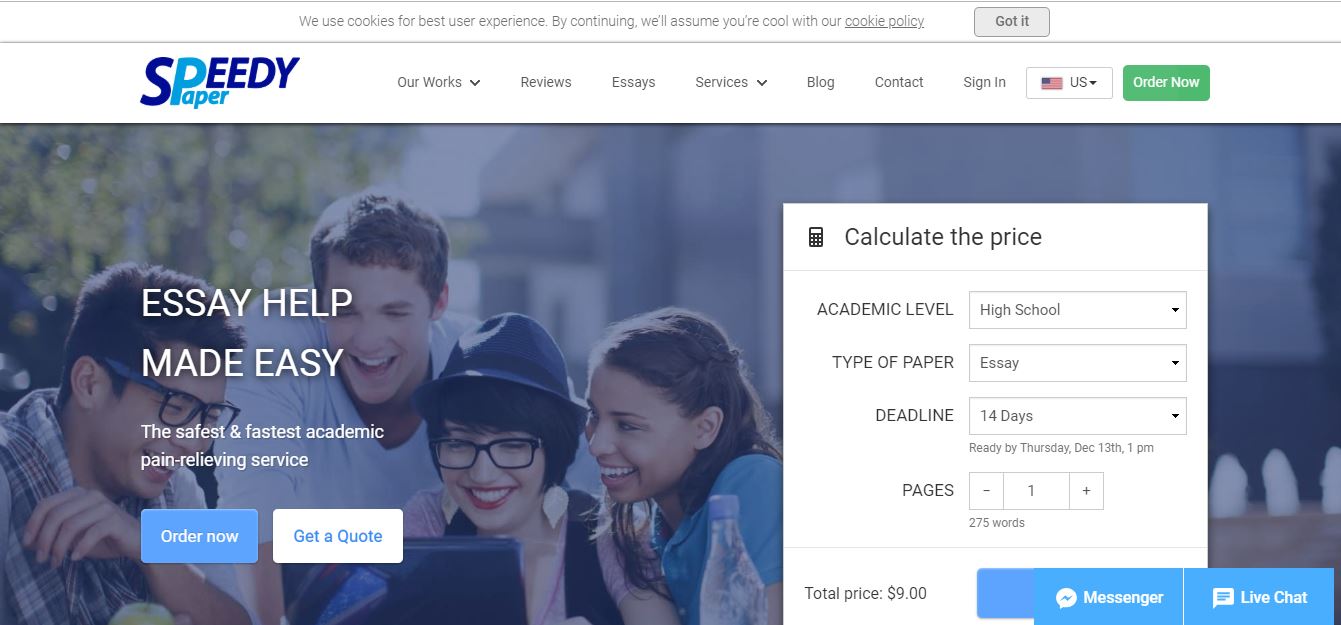
SpeedyPaper.com is an academic writing service that emphasises fast delivery as a key differentiator. While the company does deliver papers quickly relative to some competitors, speed of delivery is the only metric on which the service consistently performs. The academic quality of papers produced is a persistent concern, with essays, research papers, and dissertations demonstrating inadequate research, poor argument construction, and writing that falls below the standard required for UK university assessment.
Students who choose SpeedyPaper.com based on delivery speed find that rapid turnaround comes at the cost of academic quality. Papers are delivered on schedule but require significant revision before they can be considered submission-ready, eliminating the time advantage that speed of delivery was supposed to provide.
SpeedyPaper.com charges premium prices for its fast-delivery service model. The pricing structure penalises students with urgent requirements, exactly the circumstances when many students turn to academic writing services. While the speed premium is understandable, the quality delivered does not justify the cost.
Customer support at SpeedyPaper.com is operationally efficient in processing new orders but significantly slower in managing quality complaints. Revision requests submitted after receipt of papers are handled with none of the urgency of the original order, creating an asymmetry that disadvantages students who need rapid quality improvement.
SpeedyPaper.com delivers on its promise of speed but fails to combine this with the academic quality that students need. Speed without quality is of no value in an academic context, and students who prioritise timely delivery over quality of work risk submitting substandard papers that damage their grades.
SpeedyPaper.com scores 1 out of 5. Speed of delivery is not a substitute for academic quality, and this service consistently fails to deliver both simultaneously.
SpeedyPaper.com raises additional concerns beyond those already noted. The emphasis on speed as a primary value proposition is a red flag in the context of academic writing, where quality requires time and careful research. The company appears to maintain a large bank of pre-written academic content that is adapted and sold as original work, creating serious plagiarism risks for students. The volume of negative reviews on Trustpilot and other independent platforms significantly outweighs the positive reviews, suggesting a persistent quality problem.
For academic writing support that prioritises quality alongside timely delivery, ProjectsDeal.co.uk provides a far more responsible and reliable service than SpeedyPaper.com. ProjectsDeal.co.uk professional writers take the time needed to produce genuinely researched, original work for every order, with clear delivery timelines that balance speed with academic standards.
Thousands of UK students rely on ProjectsDeal for high-quality, guaranteed dissertation and essay support.
Best Dissertation Writing Service UK✓ Native UK Writers | ✓ 100% Plagiarism Free | ✓ Money-Back Guarantee | ✓ On-Time Delivery
SpeedyPaper.com is one of the largest and most globally recognised essay mill operations, with a significant marketing presence directed at UK university students. Unlike smaller, locally-focused services, SpeedyPaper.com operates as an international content production platform — a large-scale commercial operation that processes thousands of academic writing orders simultaneously from customers around the world. This analysis examines how that global, high-volume operational model creates specific risks for UK students, and why SpeedyPaper.com's international character is itself a risk factor that students often overlook.
The name "SpeedyPaper" positions turnaround time as the service's primary value proposition. Speed is what it offers. But academic writing of genuine quality is not a product that benefits from speed optimisation. The processes that produce good academic work — deep reading of relevant sources, critical evaluation of competing arguments, synthesis of evidence, careful drafting and revision — are time-intensive by necessity. A service whose brand identity is built on speed is structurally misaligned with the requirements of good academic writing.
UK higher education has a distinct set of academic writing conventions, citation requirements, and disciplinary expectations that differ significantly from those of other English-language higher education systems. Australian, American, and Canadian academic writing share many surface features with UK academic writing, but differ in critical respects: referencing systems (the OSCOLA system for UK law, the Harvard referencing variant used in many UK social science departments, the MHRA system standard in UK humanities), the structure and tone of critical argumentation, the expected engagement with UK-specific regulatory, legal, and policy frameworks, and the weight placed on independent critical voice versus review of existing literature.
SpeedyPaper.com's writer pool is international. Its marketing reaches students in the US, Australia, Canada, and the UK, and its writers serve all of these markets. A writer who is competent at producing work that meets the conventions of one academic system may not be familiar with the specific conventions of another. A UK law student who orders from SpeedyPaper.com may receive work that cites US case law and uses APA referencing — an immediate red flag for any UK law academic who reviews it. A UK social science student may receive work with an argument structure that reflects North American academic conventions rather than the UK's emphasis on critical literature review and theoretical positioning.
The risk of receiving work that does not conform to UK academic conventions is not merely a quality problem; it is a detection trigger. A module leader who reads an essay that cites sources in an unfamiliar referencing format, uses American English spellings, or references a regulatory framework that is irrelevant to the UK context is likely to flag the work for academic integrity review. SpeedyPaper.com's international scale, which is one of its main marketing points, is simultaneously one of its main limitations as a service for UK students.
SpeedyPaper.com facilitates what the Quality Assurance Agency for Higher Education classifies as contract cheating: the provision of academic work by a third party for submission by a student as their own. This classification applies regardless of the disclaimers SpeedyPaper.com includes in its terms of service — disclaimers to the effect that work provided is for "reference purposes only" and should not be submitted as the student's own work are routine features of essay mill legal frameworks. They provide no meaningful legal protection to students who use the work as intended, and they do not change the nature of the service.
UK universities do not consider the "reference only" disclaimer to be an operationally relevant distinction. A student who purchases work from SpeedyPaper.com and submits it to their university has committed contract cheating under their university's academic integrity policy. The fact that SpeedyPaper.com included a disclaimer in its terms of service does not affect the university's finding or its penalty. Universities base their findings on what was submitted and whether it was the student's own work, not on what the supplying service claimed its work was for.
SpeedyPaper.com operates from outside the United Kingdom, which means that it is not subject to the practical enforcement of UK consumer protection law, UK data protection law, or the QAA's guidance. Students who are dissatisfied with SpeedyPaper.com's product have essentially no consumer rights they can enforce through UK mechanisms. The company faces no UK regulatory consequences for the harm it causes to UK students; that harm is borne entirely by the students themselves.
SpeedyPaper.com processes a very large number of orders. This volume creates structural quality pressures that smaller services face less acutely. When thousands of orders are in the system simultaneously, the matching of qualified writers to appropriate orders becomes a throughput problem rather than a quality problem. Writers who can complete orders quickly are more valuable to the platform's operational model than writers who produce excellent work slowly. The platform's incentives therefore systematically favour speed over quality — the opposite of what UK academic assessment requires.
SpeedyPaper.com's large scale creates a specific detection risk that smaller services do not generate in the same way. When a significant number of students at a single institution use the same essay mill service, patterns emerge that academic integrity systems can detect. If multiple submissions to a given module or programme share structural similarities, reference unusual sources in the same way, or use stylistic patterns that are associated with a particular writing service's outputs, institutional review may flag all affected submissions simultaneously.
Academic integrity researchers have developed techniques for identifying essay mill "fingerprints" — the stylistic, structural, and sourcing patterns that characterise work produced by a particular service or writer pool. SpeedyPaper.com's high volume means that its writer pool's stylistic patterns are well represented in academic integrity research datasets, increasing the probability that submissions from the service will be identified through automated analysis.
Additionally, SpeedyPaper.com's scale increases the probability that a researcher, journalist, or regulator has obtained access to the service's order database. Several essay mill order databases have been leaked or obtained through investigative reporting in recent years, with the resulting data used to identify and notify universities about specific students who had commissioned work. A student whose SpeedyPaper.com order history is in such a database may face an academic integrity investigation initiated not by the university's own detection systems but by information provided from outside.
Every academic discipline has a minimum engagement time beneath which meaningful scholarly work is not possible. A literature review for a psychology dissertation cannot be conducted well in three hours; the reading alone requires more time than that. A legal essay that engages critically with case law and academic commentary requires careful reading of primary sources. An engineering project report that analyses data, presents methodology, and draws conclusions requires multiple drafting and revision cycles. SpeedyPaper.com offers turnaround times as short as three hours for some order types. At these turnaround times, the minimum time floor for meaningful scholarly engagement cannot be met. The product cannot be what it claims to be at these speeds, and UK students who order on this basis are certain to receive work of correspondingly limited quality.
Using SpeedyPaper.com requires students to share personal and academic data with a large international commercial platform that has no obligations under UK data protection law. The data shared typically includes the student's name, email address, university name, course and module details, assignment brief, deadline, and payment information. For dissertation-level orders, students commonly share their research topic, supervisor details, access to previous draft chapters, and module-specific feedback from their academic supervisor.
SpeedyPaper.com's privacy policy — like those of most essay mills — is written to protect the company rather than the customer. It typically reserves the right to retain personal data indefinitely, to share data with "business partners" (a broad category that may include analytics companies, marketing platforms, and resellers), and to comply with legal requests from law enforcement in the company's country of operation rather than in the student's country. None of these terms reflect the privacy protections that UK students are entitled to expect under the UK GDPR.
SpeedyPaper.com's size makes it an attractive target for data breaches. Large commercial databases containing personal and financial information from thousands of customers across multiple countries are valuable to cybercriminals. A breach of SpeedyPaper.com's customer database would expose students to identity fraud, financial fraud, and — uniquely, given the nature of the service — targeted extortion based on their order history. Students whose data is held by SpeedyPaper.com cannot verify how it is stored, who has access to it, or whether it has already been compromised.