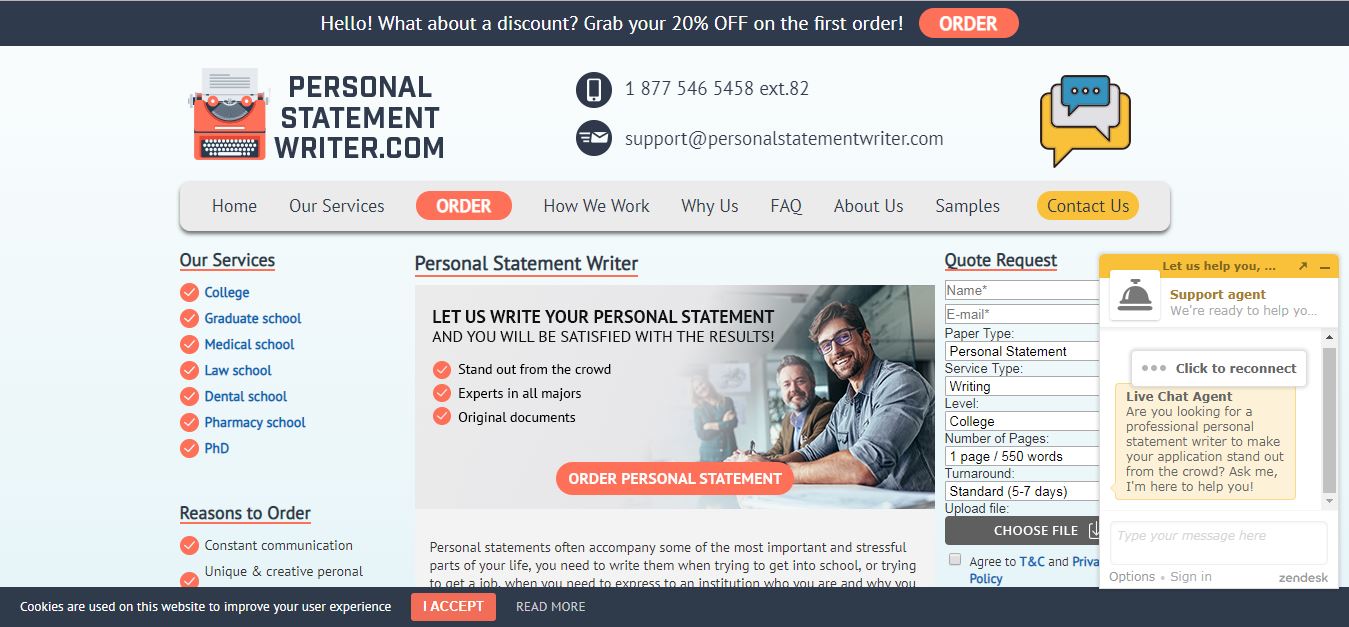
personalstatementwriter.com Reviews
Services
PersonalStatementWriter.com offers to write personal statements for university applications, professional admissions, and scholarship bids. Personal statements are among the most important documents a student produces, and the quality of the writing must authentically represent the individual voice, experience, and aspirations. The statements produced by this company are generic, overly formal, and fail to capture the personal narrative required to stand out in competitive admissions processes.
For Students
Students using PersonalStatementWriter.com for UCAS applications, postgraduate admissions, or professional training programmes report receiving statements that bear no resemblance to their personal experiences. Writers rely on stock phrases and generic achievement language rather than engaging with the specific details of the student background. The resulting statements are indistinguishable from thousands of others, placing students at a disadvantage in competitive admissions pools.
Prices
Personal statement writing services command a premium, and PersonalStatementWriter.com charges accordingly. The prices do not reflect the quality of the output, which is closer to a generic template than a bespoke document. Rush fees for applications with imminent deadlines further inflate costs without improving quality. The company does not guarantee admission success and offers no refund if the statement fails to support a successful application.
Customer Support
Customer support at PersonalStatementWriter.com is available but limited in scope. Support agents can process orders and handle administrative queries but lack the admissions expertise to address concerns about the strategic content of personal statements. When students request revisions to make statements more authentic or specific, the revisions made are cosmetic rather than substantive.
Conclusion
PersonalStatementWriter.com does not provide the personalised, authentic statement writing support that students need for competitive admissions processes. Submitting a statement written by this service risks rejection on authenticity grounds and fails to showcase the genuine strengths of the applicant. Students should work with university admissions advisors, subject-specialist tutors, or skilled personal mentors.
Result
PersonalStatementWriter.com scores 1 out of 5. The generic quality of statements produced by this service is likely to harm rather than help admissions prospects.
Warning Signs to Watch Out For
PersonalStatementWriter.com raises concerns that go beyond quality alone. Personal statements contain sensitive personal information about applicants, and students should consider carefully how this information is stored and protected. The company does not provide clear data protection policies, and students have reported having their personal details used for marketing without consent. The quality of statements produced also suggests that writers do not allocate sufficient time per client to produce genuinely personalised content.
Our Recommendation
The most effective personal statements are those written with your own authentic voice, with professional guidance and editing support. For students who need support beyond personal statements, including dissertations and essays, ProjectsDeal.co.uk provides trusted academic writing assistance backed by UK-qualified writers.
Looking for a Trusted UK Writing Service?
Thousands of UK students rely on ProjectsDeal for high-quality, guaranteed dissertation and essay support.
Best Dissertation Writing Service UK
✓ Native UK Writers | ✓ 100% Plagiarism Free | ✓ Money-Back Guarantee | ✓ On-Time Delivery
⚠ personalstatementwriter.com — Why Paid Statement Writing Is a Risk You Cannot Afford
Paying for a personal statement through personalstatementwriter.com or any comparable ghost-writing service puts your entire university application at risk. UCAS and UK universities treat submitted statements as the applicant's own authentic voice. A purchased statement is a misrepresentation from the first word — and the consequences compound far beyond a rejected application.
What Is a UCAS Personal Statement Actually For?
Before examining what personalstatementwriter.com sells, it is worth understanding what the personal statement is genuinely designed to assess. UCAS's own guidance makes the purpose explicit: the statement is your opportunity to demonstrate genuine passion for your subject, relevant experience and skills, and your capacity for independent thought at degree level.
Admissions tutors read hundreds of statements for each course. What they look for is not a polished marketing document — it is authentic intellectual curiosity and evidence that the applicant can sustain the demands of their chosen degree. A statement written by a professional service will, at best, fail to reflect these qualities and, at worst, be indistinguishable from dozens of other purchased statements the tutor has already seen.
What Admissions Tutors Seek vs What Paid Services Deliver
| What Tutors Are Looking For | What personalstatementwriter.com Provides | The Problem |
|---|
| Genuine motivation for the specific subject | Generic enthusiasm constructed from research | Tutors probe motivation at interview; scripted answers collapse |
| Evidence of independent reading beyond A-level | References to books and journals chosen by the writer | Applicant may not have read the cited sources |
| Personal reflection on experiences | Constructed narratives based on brief questionnaire | Misrepresents actual experiences; exposed under questioning |
| Clarity of academic goals | Plausible-sounding future plans | May contradict what applicant says in teacher reference |
| Authentic voice consistent with GCSE and A-level writing | Professional adult prose at a different register | Stylistic mismatch flagged by plagiarism detection tools |
How UCAS Detects Purchased Personal Statements
The belief that a purchased statement from personalstatementwriter.com cannot be detected is a significant misconception. Detection mechanisms are more sophisticated than many applicants realise.
- Similarity Detection System: UCAS operates an automated similarity detection system that compares all submitted statements against each other and against a database of statements from previous years. Phrases, sentence structures and thematic sequences that appear in multiple statements trigger a flag. Services that use template-based approaches — including many that operate through platforms like personalstatementwriter.com — are particularly vulnerable to this detection.
- Stylometric Analysis: Universities increasingly use stylometric tools that compare writing patterns between the personal statement and samples of the applicant's own writing — particularly A-level coursework submitted as part of the application process. Vocabulary range, sentence length variation, punctuation habits and common phrasing all create a fingerprint. A purchased statement from personalstatementwriter.com will not match this fingerprint.
- Interview Consistency Checks: For many competitive courses — medicine, law, Oxford and Cambridge subjects, and most Russell Group programmes — the personal statement is used as the primary structure for interview questions. An applicant cannot rely on having read or experienced what a professional writer claimed in their name.
- Teacher Reference Cross-Checking: UCAS requires a reference from a teacher or adviser who knows the student. Experienced tutors are alert to discrepancies between what a reference says about a student and what a statement claims. A sophisticated purchased statement may read more impressively than the teacher believes the student capable of — itself a red flag.
- AI Detection Tools: A growing number of universities now run statements through AI content detection alongside plagiarism checks, given that some statement services use AI generation to reduce costs.
The Interview Problem: What Happens When a Purchased Statement Meets a Tutor
For the majority of competitive university courses in the UK, an interview is a standard part of the admissions process. The personal statement is the primary document an interviewer uses to structure that conversation. This creates a serious and predictable problem for anyone who has used a service like personalstatementwriter.com.
The writer at personalstatementwriter.com constructed a statement from a brief questionnaire or call. They wrote about books they imagined you might have read, experiences they assumed were plausible, and intellectual interests that sounded appropriate for the subject. The statement may be well-crafted. But in a 30-minute interview, a tutor who asks even moderately specific questions about any of these elements will quickly discover that the passion and insight described on the page is not present in the conversation.
Subjects That Interview: Risk Levels for Purchased Statements
| Subject Area | Interview Likelihood | Personal Statement Use in Interview | Risk if Statement Is Purchased |
|---|
| Medicine / Dentistry / Veterinary | Almost universal at top schools | Detailed questioning on work experience and motivation | Extreme — interview collapse near certain |
| Law | Common at Russell Group | Books and cases cited tested in depth | Very high — reading knowledge tested immediately |
| PPE / Politics / Economics | Standard at Oxford, LSE | Current affairs, economic concepts and arguments probed | Very high |
| English Literature | Common at many universities | Texts cited must be discussed intelligently | High |
| Computer Science / Engineering | Common at technical universities | Projects and skills described are verified | High if fabricated projects cited |
| Business / Management | Selective at top business schools | Work experience and commercial awareness examined | Moderate to high |
Writing Your Own Personal Statement: A Step-by-Step Approach
The most effective alternative to using personalstatementwriter.com is to write your own statement using a structured approach over several weeks. This produces a document that reflects your genuine voice, stands up to interview scrutiny, and is consistent with the rest of your application.
- Subject reflection (Week 1): Write a list — not for the statement, just for yourself — of every moment in the last two years when you found a topic genuinely interesting. This includes lessons, books, articles, documentaries, conversations, work experience, clubs or competitions. Do not filter for impressiveness. Filter for honesty.
- Reading and experience inventory (Week 2): List the books, articles and sources you have actually engaged with. Include things you did not finish or partially disagreed with — that intellectual friction is often more interesting to admissions tutors than uncritical enthusiasm. Also list relevant work experience, volunteering, projects and positions of responsibility.
- First draft without editing (Week 3): Write 1,000 words describing your interest in the subject using only the material from your two lists. Do not look at sample statements. Do not worry about the UCAS word limit. Write as though explaining your interest to an intelligent adult who is not an expert. This draft will be rough — that is the point.
- Subject teacher review: Give your rough draft to your subject teacher, not a personal tutor or parent. Ask specifically: "Does this sound like me, and does it accurately reflect my understanding of the subject?" Their answer will tell you more than any personal statement service could.
- Editing to UCAS format (Week 4-5): Cut to 4,000 characters. Prioritise specificity over generality — "I was struck by the argument in [actual book you read] that [specific idea]" is always stronger than "I have always been fascinated by [subject]." Remove every cliché your subject teacher identifies.
- Final review for interview preparation: Read the statement as though you are an interviewer. For every claim you make, ask: "Could I discuss this for five minutes?" If not, either cut the claim or do the reading that would let you discuss it.
The Legal and Ethical Dimension of Paid Statement Services
- Is using personalstatementwriter.com illegal?
- There is no specific criminal statute that makes buying a personal statement illegal for the applicant. However, submitting it as your own work to UCAS constitutes a deliberate misrepresentation in an official application. UCAS's own declaration requires applicants to confirm the statement is their own. Submitting purchased content while signing that declaration is the basis on which universities withdraw offers and, in some cases, report applicants to UCAS for formal investigation.
- What does personalstatementwriter.com's own terms say about liability?
- Services of this type typically include terms that disclaim any responsibility for the consequences of submitting their content to UCAS or universities. The liability rests entirely with the applicant. If an offer is withdrawn or a place revoked, the service that sold you the statement bears no legal obligation to compensate you for any losses — including tuition fees already paid or accommodation already committed to.
- Are there specific university policies that address this?
- Yes. Most UK universities now include purchased personal statements in their academic misconduct and admissions fraud policies. The University of Manchester, UCL, King's College London, and others have published explicit guidance stating that submitting a purchased personal statement is treated as fraud and may result in the permanent withdrawal of any offer. These policies apply retrospectively — meaning a place can be revoked after a student has already arrived, if fraud in the application is subsequently discovered.
- What about the writers at personalstatementwriter.com — are they accountable?
- Writers employed or contracted by services like personalstatementwriter.com face no legal or professional sanction under current UK law. The 2022 higher education integrity legislation tightened rules around contract cheating in academic settings but personal statement services continue to operate in a legal grey area. The absence of legal consequences for the service does not reduce the consequences for the applicant.
Legitimate Support for Personal Statement Writing
There is substantial, genuinely useful support available for applicants writing their own statement that does not put your application at risk.
Your Subject Teacher
The single most valuable reviewer. They know your actual ability, understand what the subject requires, and can identify genuine interests to develop. Advice from a teacher who knows you is worth more than any paid service.
UCAS Official Guidance
UCAS publishes detailed, free guidance on writing a personal statement, including subject-specific tips, example structures, and a checklist. This guidance is written by people who have read thousands of successful statements.
School or College UCAS Coordinator
Every UK secondary school and sixth form college that participates in UCAS has a designated coordinator whose role includes supporting personal statement drafts. This support is free, experienced and understands what individual universities want.
University Open Days
Almost every UK university holds open days where admissions tutors and current students answer questions. Many universities offer personal statement workshops at open days — these sessions are free and provide direct insight from the people making decisions.
The Student Room
The Student Room forum has an extensive personal statement section where current and former applicants discuss approaches, share generic examples (not for copying), and offer peer feedback. Crowd-sourced experience from successful applicants is a genuinely useful resource.
Subject Society and Reading Lists
Most UK university departments publish recommended reading lists for applicants. Engaging with even one or two items on these lists gives you genuine material to write about — and ensures you can discuss it in interview. This is more effective than any purchased statement.
Frequently Asked Questions About personalstatementwriter.com
"The service says writers are former admissions tutors — doesn't that make it safer?"
Whether or not a writer at personalstatementwriter.com previously worked in admissions does not change the fundamental issue: the statement is not your own work, and you are submitting it as though it is. A statement's quality is irrelevant to whether it constitutes misrepresentation. An extremely well-written purchased statement that matches the expected profile of a successful applicant may be more likely to secure an interview — at which point the divergence between the statement and the applicant becomes most apparent, not less.
"I'm not a native English speaker — isn't it fair to get help with the writing?"
Having a statement substantially rewritten by a native English speaker — to the point where it no longer reflects your own voice and ideas — is not the same as having grammatical errors corrected. Universities are fully aware that many applicants are not native English speakers. The statement is specifically understood as a document where language support is natural. What universities are evaluating is your intellectual engagement with your subject, not your English fluency in isolation. An international applicant who writes with some grammatical errors but genuine insight will be more competitive than one who submits a polished statement that does not withstand interview scrutiny.
"Could the service just be editing my own draft rather than writing the whole thing?"
personalstatementwriter.com and services like it offer both draft-from-scratch and editing services. Light proofreading — correcting spelling, grammar, and punctuation — does not constitute misrepresentation. Substantial rewrites that change the content, ideas, and voice of your statement cross the line that UCAS and universities draw. The service's own marketing typically emphasises the quality of the final product, not the integrity of the underlying process — which is the only thing that matters when a university investigates your application.
Summary Warning
personalstatementwriter.com sells a document you cannot safely use. The UCAS declaration you must sign states the statement is your own. Submitting purchased content means signing a false declaration to a national applications body. The consequences — from withdrawn offers to retrospective removal of a degree after graduation, if fraud is discovered later — fall entirely on you, not on the service that sold you the statement.
The Personal Statement as Interview Preparation
This section addresses something that most guides about UCAS applications, and certainly no service like personalstatementwriter.com, adequately explains: writing your own personal statement is itself the best preparation for the interview that personal statement may earn you.
When you spend three to six weeks working through your genuine interests, identifying the books and experiences that have actually shaped your understanding, and finding the most honest way to articulate your motivation, you are doing the intellectual work that will sustain a 45-minute interview conversation. A statement purchased from personalstatementwriter.com does none of this work for you — it does the opposite, by putting claims into your application that you will then have to either research after the fact or fail to answer convincingly.
Admissions tutors at competitive universities specifically design interviews around this dynamic. They expect applicants to arrive having thought deeply about the subjects mentioned in their statement. An applicant who says they were inspired by a particular philosopher and can discuss even a few of that philosopher's central arguments is dramatically more competitive than one who mentions the same philosopher but cannot say what they actually wrote. The purchased statement creates the impression without the substance.
Competitive Courses: What Interviewers Ask From Personal Statements
| Course Type | Typical Interview Structure | What They Ask From the Statement | Time Spent on Statement Content |
|---|
| Oxford / Cambridge (all subjects) | 2–3 interviews, 30–45 min each | All books, experiences, activities mentioned | 60–100% of interview time |
| Medicine (most schools) | MMI circuit or panel interview | Work experience, motivation, ethical scenarios | 40–70% of interview time |
| Law (Russell Group) | Panel or one-to-one, 20–30 min | Cases and issues cited, commercial awareness | 30–50% of interview time |
| Engineering (Imperial, UCL) | Technical problem-solving + background questions | Projects, skills, specific interests described | 20–40% of interview time |
| Social Sciences (LSE, UCL) | Discussion-based, 25–40 min | Theoretical frameworks, current events referenced | 30–50% of interview time |
Your Subject Teacher's Role — and Why It Matters More Than Any Paid Service
A recurring theme in advice from admissions tutors at UK universities is the importance of the relationship between an applicant and their subject teacher when preparing a personal statement. This is not accidental.
Your A-level or IB subject teacher is the person who has observed your intellectual development over two years. They know which topics you engaged with most seriously, which questions you asked that went beyond the syllabus, and where your genuine strengths lie. They can identify authentic material for your statement that no service like personalstatementwriter.com could discover from a questionnaire or brief consultation.
Beyond content, your subject teacher also writes — or contributes significantly to — your UCAS reference. The reference and the personal statement are read together by admissions tutors. A reference that describes a student as competent but average, alongside a statement that claims exceptional intellectual depth and self-directed learning, creates immediate doubt. Your teacher cannot honestly endorse material in a statement they did not believe you were capable of writing.
Common Mistakes in Personal Statements and How They Signal Inauthenticity
| Common Mistake | Why It Appears in Purchased Statements | How Tutors Identify It |
|---|
| Opening with a quotation or sweeping claim | Writers trained in persuasive structures gravitate toward these openings | UCAS similarity detection flags common opening lines; tutors recognise the formula |
| Citing canonical texts without specificity | A writer without knowledge of applicant's actual reading defaults to safe, well-known titles | No evidence of engaging with specific arguments; "inspired by Darwin" with no mention of what |
| Over-formal, adult register inconsistent with age | Professional writers write in professional register | Stylometric mismatch; different from handwriting sample or coursework |
| Vague work experience described in abstract terms | Writer doesn't know specific details of actual placement | Cannot answer specific questions at interview; reference mentions no such experience |
| Interests that perfectly match the course without texture | Constructed to optimise for admissions criteria rather than reflect real development | No sense of intellectual journey or honest difficulty; reads as a marketing document |
| Future career goals stated with overconfidence | Writers use confident future framing to signal commitment | At interview, cannot explain the basis for career certainty or knowledge of the profession |
What UK University Admissions Policy Actually Says
The Higher Education (Freedom of Speech) Act 2023 and the ongoing review of admissions integrity by the Office for Students (OfS) have both increased institutional pressure on universities to formalise their approach to application fraud. Several developments are directly relevant to anyone considering personalstatementwriter.com or similar services.
- OfS Registration Conditions: All registered English universities must maintain and enforce academic integrity policies. These explicitly cover the admissions process, not just in-course assessment. A university that fails to investigate or act on identified admissions fraud risks losing OfS registration.
- UCAS Investigation Process: UCAS can investigate suspected fraud during and after the application cycle. Investigations are not limited to the current year — a complaint made by a university about a student already enrolled can trigger retrospective review of the application.
- Criminal Fraud Act 2006: While UCAS does not typically pursue criminal referrals for individual applicants, the Fraud Act 2006 technically covers false representations in official applications. The primary route for consequences remains the university admissions process rather than criminal prosecution — but the legal framework exists.
- Degree Classification Impact: Students who enter a programme for which their authentic preparation was insufficient — because a purchased statement secured them a place they were not genuinely competitive for — tend to underperform in assessments from the first semester. The statement may have worked; the degree outcome often does not.
What Admissions Tutors Actually Read For
- Intellectual curiosity that goes beyond the syllabus
- Tutors are specifically looking for evidence that the applicant has engaged with their subject outside the demands of A-level or IB assessment. This might be a topic studied independently, a question raised by classroom learning that the applicant pursued through additional reading, or an idea encountered through a lecture series, podcast, or journal article. The key is that the curiosity must be genuine — and any service like personalstatementwriter.com that constructs this evidence from scratch is creating something that cannot withstand a direct question about the experience it describes.
- Critical engagement rather than passive admiration
- The strongest personal statements — according to admissions tutors across multiple Russell Group institutions — do not simply praise a book or experience. They show that the applicant engaged critically: noticing a limitation, asking a follow-up question, disagreeing with part of an argument, or making a connection to another area of knowledge. This kind of critical engagement cannot be genuinely constructed by a writer at personalstatementwriter.com who has not shared the applicant's intellectual development.
- Relevance of extracurricular experience to the subject
- Where extracurricular activities are included, the strongest statements draw a clear and honest connection between those activities and the specific skills or perspectives relevant to the intended degree. Generic leadership qualities and teamwork achievements — the safe fallback content of many paid statement services — are significantly less effective than a specific experience that connects directly to academic interest, however modest that experience was.
- Awareness of what the degree actually involves
- Applicants who have spoken to current students, attended open days, or researched the actual structure and content of the degrees they are applying for are significantly more compelling than those who describe an idealised version of the subject. A statement purchased from personalstatementwriter.com that describes a generic enthusiasm for law is less competitive than an applicant who mentions what specific module or research area at a particular university excited them.
Post-Offer Implications: What Happens After personalstatementwriter.com Secures You a Place
Even in the scenario where a statement purchased from personalstatementwriter.com results in a successful application — the offer is made and accepted, the required grades are achieved, and the student enrols — the risks do not disappear. They transform.
A student who entered a highly competitive programme on the basis of a statement that misrepresented their preparation and interest faces the following scenario: the first weeks of lectures in a subject at degree level assume the genuine curiosity and foundational reading that a successful applicant should have. A student who arrived because a purchased statement impressed an admissions tutor, rather than because their authentic preparation was competitive, often finds themselves significantly behind peers from the opening seminars.
Beyond academic challenge, the purchased statement creates an ongoing misalignment between how the university understands the student — based on the application — and who the student actually is. Personal tutoring, academic support, and career advice are all shaped by the information in the application. Where that information was fabricated by personalstatementwriter.com, the support received may be mis-targeted from the start.
Practical Timeline for Writing Your Own Statement
- June–July (Year 13): Begin a subject reading journal — note what you read, what argument you found most interesting, what question it raised. This is raw material. Do not write for an audience.
- August: Attend university open days. Attend subject talks specifically. Ask questions. Take notes on what the tutors emphasise. Speak to current students about what the first year was actually like.
- Early September: Draft a 500-word version of your motivation using only what you have recorded in your journal and what you observed at open days. Give this to your subject teacher for a reality check.
- Mid September: Expand to a full draft of approximately 700 words. Ask your UCAS coordinator and subject teacher to review separately. Discuss their feedback with both of them.
- Late September: Edit to the UCAS character limit (4,000 characters excluding spaces, or 47 lines). Focus on removing generic claims and ensuring every specific example you include is one you can discuss at interview.
- Early October: Final review focused specifically on interview preparation. Read your statement as a hostile questioner would. For every claim: "Can I sustain a five-minute conversation about this from genuine knowledge?" Cut anything you cannot.
- Mid October: Submit. The UCAS deadline for most courses is January; Oxford, Cambridge and most medicine courses require October submission.
The Authenticity Advantage: Why Your Own Statement Outperforms personalstatementwriter.com
The final case against using personalstatementwriter.com is not primarily about risk. It is about quality and outcome.
A genuine, carefully drafted statement that reflects your actual interests, your real reading, and your honest motivation is almost always more compelling than a constructed document — because it contains the one element no paid service can replicate: specific personal experience rendered in authentic voice.
Admissions tutors read purchased statements regularly. They are experienced at recognising the markers of professional construction: the perfect relevance of every reference, the adult register inconsistent with a seventeen-year-old's voice, the absence of any rough edges or honest difficulty. A real statement includes the book that confused you, the work experience that wasn't quite what you expected, the question you couldn't answer that made you more curious about the subject. These imperfections are not weaknesses — they are the evidence that a human being with a genuine relationship to the subject wrote this document.
Graduate and Postgraduate Application Risks
The consequences of using personalstatementwriter.com extend beyond undergraduate admission. For applicants who go on to apply for graduate programmes, postgraduate qualifications, professional accreditation, or competitive scholarships, a history of misrepresentation in their undergraduate application can resurface in ways that are difficult to predict.
Graduate School References
Graduate admissions require references from undergraduate tutors who know the student's academic work. A tutor who discovers that a student's undergraduate application misrepresented their entry preparation may decline to provide a strong reference for graduate study, or may raise concerns in the reference itself.
Professional Training Applications
Applications for medical foundation programmes, graduate legal training (LPC/BTC), PGCE teacher training, and other regulated professional pathways all require disclosure of any academic misconduct or admissions integrity issues from prior applications. A formal finding against an applicant from their UCAS application must typically be disclosed.
Competitive Scholarships
Rhodes, Chevening, Marshall, Fulbright and other major scholarships conduct thorough background checks that include contact with undergraduate institutions. Any flag on an academic record related to application integrity is likely to surface during these checks.
Employer Background Checks
Employers in regulated sectors (finance, law, government, teaching, healthcare) conduct degree verification checks that involve direct contact with the awarding institution. Any flag on the graduate's academic record that emerged during their studies — including retrospective investigation into their application — may be disclosed.
Key Contacts and Resources for Personal Statement Support
| Resource | What It Offers | Cost | How to Access |
|---|
| UCAS Personal Statement Tool | Official guidance, character count, submission | Free | ucas.com |
| Your school/college UCAS coordinator | Draft feedback, reference coordination, deadline management | Free | Contact via school |
| University open days and taster days | Subject-specific insight, direct tutor contact, student perspectives | Free (travel costs) | University websites |
| The Student Room forums | Peer experience, general personal statement section, subject-specific discussions | Free | thestudentroom.co.uk |
| School librarian or public library | Access to subject introductory texts, reading list books | Free | In person |
| University admissions webinars | Recorded guidance on what admissions tutors look for, by subject | Free | University YouTube channels and websites |
The Case for Writing Your Own Statement
- A genuine statement survives interview scrutiny that a purchased one from personalstatementwriter.com cannot
- The process of writing your own statement prepares you for exactly the questions you will be asked
- Authentic voice is recognisable to experienced tutors and strengthens, not weakens, your application
- You know the content of your own statement and can refer to it honestly when universities contact you
- Your UCAS declaration is signed truthfully, with no risk of later investigation
- Your subject teacher can honestly endorse a statement they recognise as your own work
- The skills developed in drafting a personal statement — synthesis, self-analysis, clear argument — are exactly the skills the first year of a degree will require
This review is published by bestwritingcompanies.co.uk. Information is for guidance only. Admissions policies vary by institution; consult UCAS official guidance and your own school or college for advice specific to your application. Last reviewed October 2027.