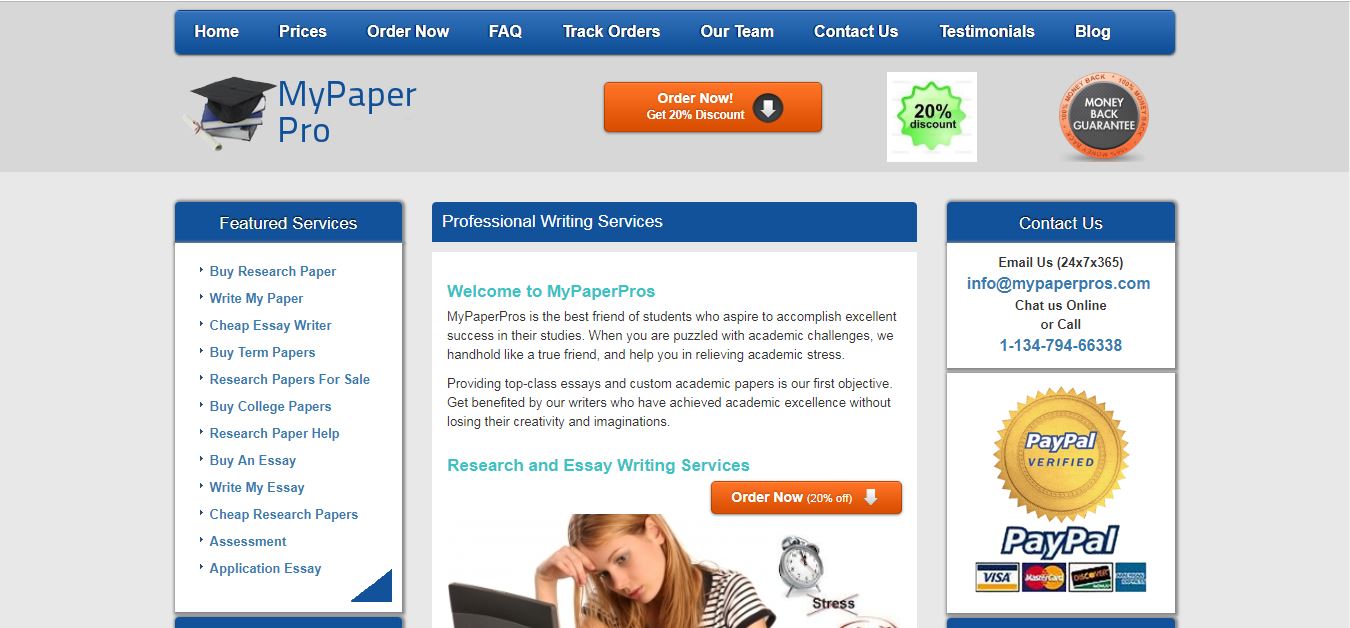
MyPaperPros.com Review: The "My Paper" Personalisation Promise That Falls Apart Under Scrutiny
The name MyPaperPros.com is a carefully constructed piece of brand positioning that does three things simultaneously: it creates a sense of personal ownership ("My"), it emphasises professional quality ("Pros"), and it establishes what the service produces ("Paper"). The "My" in mypaperpros-com is particularly significant from a marketing perspective — it implies that the service produces work that is specifically yours: tailored to your assignment, your academic profile, your writing style, your institution's requirements. This personalisation promise is central to why students trust mypaperpros-com with their academic submissions. It is also one of the most misleading elements of the service's positioning.
Our investigation of mypaperpros-com examined both the personalisation claims the service makes and the actual product quality it delivers. The findings show a significant gap between the "My Paper" brand promise and the operational reality of how mypaperpros-com produces and delivers academic work. Understanding this gap is essential for students who are considering trusting mypaperpros-com with academic submissions that will carry their name and affect their degree classification.
This review also examines the academic integrity risks specific to personalisation-claiming services: the particular ways in which work that is marketed as personal and tailored can still be detected as externally produced, and why the "pro" quality claim at mypaperpros-com does not translate into the detection-resistance that students assume it implies.
The Personalisation Illusion at MyPaperPros.com
When a student orders from mypaperpros-com, they provide their assignment brief, their academic level, their deadline, and often additional details about their course and institution. The service's interface presents this information collection as the beginning of a personalised service — a professional taking careful note of your specific requirements before crafting work that is genuinely yours. This experience creates a sense of ownership that makes students feel the resulting work is safely personal to them.
The operational reality at mypaperpros-com is different. The information you provide becomes an order brief that is distributed to available freelance writers in the service's pool. The writer who accepts the brief reads it — sometimes thoroughly, sometimes cursorily — and produces work that addresses the stated requirements. This is not personalisation in any meaningful sense. It is a specification-following exercise performed by someone who does not know you, does not know your institution, does not know your module, and does not know the specific academic context in which the submission will be evaluated.
Genuine personalisation in academic work — the kind that makes a submission authentically yours — is not about addressing the stated requirements of an assignment. It is about the integration of your specific learning journey: the way you have engaged with the module's material, the particular arguments that interest you, the specific connections between course content and your existing knowledge, the intellectual style that has developed through your years of education. None of this can be provided to mypaperpros-com through an order brief, because most of it is not even consciously articulable by the student themselves. It exists in the person, not in the brief.
When mypaperpros-com delivers your "my paper," it delivers a competent piece of academic writing that addresses the stated requirements. What it does not deliver is work that is authentically yours — work that reflects your individual engagement with the subject, your intellectual development, and your personal academic voice. This is the personalisation gap at mypaperpros-com, and it is the gap that makes the service's product detectable as externally produced.
How "Pro" Quality at MyPaperPros.com Compares to Student Work
The "pros" designation at mypaperpros-com implies that the work produced will be of higher quality than typical student work. This creates a specific detection dynamic that students do not anticipate: work that is professionally written but not authentically authored creates a quality inconsistency that is itself a detection signal. A student who submits work that is significantly above their demonstrated academic level attracts scrutiny precisely because of its quality.
Academic assessors who mark work across cohorts have calibrated expectations for the quality range within their student population. A student whose seminar contributions, previous assignments, and class participation reflect a mid-range understanding of the subject who submits a polished, professionally written assignment demonstrates a quality level inconsistent with their established profile. This inconsistency is a standard detection signal in academic integrity investigations — and it is more likely, not less, when students use a service like mypaperpros-com that claims to deliver "pro"-quality work.
Students who believe that high-quality writing from mypaperpros-com will protect them from detection are therefore working from a mistaken assumption. In some cases, the quality of mypaperpros-com work actively increases detection risk by creating a quality inconsistency that marks the submission as anomalous. The "pro" quality claim is a selling point that simultaneously creates a new category of detection risk for the student who uses it.
This does not mean that poor-quality work from mypaperpros-com is safer — it is not. It means that the relationship between quality and detection risk is more complex than the mypaperpros-com brand implies, and that neither the "pro" quality promise nor the "my paper" personalisation promise provides the protection students assume they do.
What MyPaperPros.com Cannot Know About Your Assignment
Academic assignments are embedded in specific institutional contexts that mypaperpros-com cannot access. The module in which an assignment appears has been taught in a specific way, by a specific instructor, using specific materials, building toward specific learning outcomes. The assignment brief that students provide to mypaperpros-com captures the explicit requirements of the task but cannot capture the implicit context that the marking instructor will use to evaluate submissions.
Consider what is typically not in an assignment brief that significantly affects what a good submission looks like: the specific theoretical frameworks emphasised in lectures; the particular texts the module has focused on and the specific readings the instructor expects to see engaged with; the analytical approaches demonstrated in seminars; the examples and case studies used in teaching that would logically appear in strong student submissions; the common misconceptions the instructor has specifically warned against; and the specific conventions of the discipline as practised at this institution and in this module.
Students who submit work from mypaperpros-com submit work that addresses the explicit brief but misses all of this implicit context. Experienced markers notice these misses. A submission that does not engage with the texts the course has been reading, that uses examples from outside the module's frame of reference, that applies analytical frameworks that were not introduced in the module, or that avoids the specific analytical approach the module has been building — this submission stands out as one that was not produced by someone who attended the module. The "my paper" at mypaperpros-com is missing the most important personalisation: the specific institutional and pedagogical context of the assignment it is supposed to respond to.
MyPaperPros.com Customer Experience: What the Reviews Don't Tell You
Customer reviews for mypaperpros-com on third-party platforms present a mixed picture that requires careful interpretation. Positive reviews for mypaperpros-com tend to focus on surface-level satisfaction: the paper was delivered on time, the writing was competent, the format was correct. These are the criteria that customers can evaluate immediately on delivery. What they cannot evaluate at delivery — and what the reviews therefore do not capture — is the most important dimension: whether the work will survive academic scrutiny.
The time delay between ordering from mypaperpros-com and discovering whether the submission created academic integrity consequences means that positive delivery experiences and negative academic outcomes are separated in time and therefore in review platforms. A student who orders from mypaperpros-com in October, submits in November, and discovers in February that they are under academic integrity investigation for the November submission will not typically update their October delivery review to reflect the February consequence. The review profile for mypaperpros-com therefore systematically underrepresents the academic integrity outcomes associated with the service.
The negative reviews for mypaperpros-com do surface problems that are detectable at delivery: missed deadlines, poor formatting, incorrect citation styles, failure to address specific requirements, and communication problems with the assigned writer. These complaints, while significant, actually represent the less severe category of mypaperpros-com failures. The more severe failures — work that passed quality review but triggered academic integrity investigation — are invisible in review data because the connection between the delivery and the consequence is temporally remote and often not attributed to the service by students who have moved on.
The Academic Integrity Risk of MyPaperPros.com: Specific Vulnerabilities
Submissions from mypaperpros-com carry specific academic integrity vulnerabilities that students should understand before placing an order. These vulnerabilities are not limited to plagiarism detection — they encompass the full range of tools and approaches that academic institutions use to identify work that was not produced by the submitting student.
Stylometric analysis — the computational examination of writing style features including sentence length distribution, vocabulary richness, punctuation patterns, and syntactic structures — can identify writing that is inconsistent with a student's established academic voice. Universities that maintain writing samples from previous submissions can compare submitted work against these samples using stylometric tools. Work from mypaperpros-com that has a writer's distinctive style will show a stylometric profile different from the student's own. This comparison can flag submissions for further investigation without any direct evidence of contract cheating.
Metadata analysis of submitted documents can reveal authorship information inconsistent with the submitting student. While sophisticated students know to clean metadata before submission, many do not. Work produced by mypaperpros-com and submitted directly — even after format adjustment — may carry metadata traces of the original writing environment that are inconsistent with the claimed authorship. Digital forensics applied to academic submissions is an emerging field with growing institutional application.
AI writing detection tools are increasingly deployed at UK universities to complement traditional plagiarism detection. These tools analyse the statistical patterns of submitted text to identify writing that exhibits the distinctive characteristics of AI-assisted or AI-generated content. If mypaperpros-com writers use AI assistance in producing work (a practice that is common and growing in the writing mill industry), submissions from mypaperpros-com may be flagged by these detection tools independently of stylometric analysis.
Structural and argumentative analysis by experienced markers remains the most reliable detection mechanism. Markers who are expert in their field and who have taught the module know what genuine student engagement with the subject looks like at the assessed level. Work that is technically competent but intellectually generic — that addresses the assignment question but does not reflect the specific learning of the module — is distinguishable from authentic student work by markers who have read hundreds of submissions from students in the same cohort.
MyPaperPros.com Pricing and Value Analysis
Mypaperpros-com operates in the mid-range of essay mill pricing, with rates that reflect both the "my paper" personalisation promise and the "pros" quality claim. These two brand elements justify pricing above the lowest-cost mills while positioning the service as accessible to students who cannot afford premium rates. The pricing proposition is designed to make mypaperpros-com appear as a value option relative to what is framed as a premium quality service.
Genuine value analysis of mypaperpros-com requires accounting for the full cost profile, not just the per-page rate. The full cost includes: the per-page base rate; the writer level premium for supposedly better-quality work; the rush premium for tight deadlines; the revision time cost (in student hours spent requesting and reviewing revisions); and the academic integrity risk premium — the expected cost of the probability-weighted consequences of detection multiplied by their severity.
When the academic integrity risk premium is included, mypaperpros-com represents significantly negative expected value for the average student in the average submission context. The service is priced competitively for the product it explicitly delivers (a piece of academic writing), but it does not price in the risk it implicitly delivers (the probability of consequences that can include course failure, academic penalty, and in serious cases, expulsion). Students who understand this full cost picture find that mypaperpros-com is not a value option — it is an expensive risk, priced as if the risk were not part of the product.
Alternatives to MyPaperPros.com That Actually Work
Students who are drawn to mypaperpros-com because they need academic writing support have access to better alternatives that provide the support they need without the risks the service creates. The key is to match the type of support to the type of difficulty.
If the difficulty is time — not enough time to complete an assignment properly — the correct response is to seek an extension rather than to outsource the work to mypaperpros-com. Extension policies at UK universities have evolved significantly in recent years, with many institutions now offering self-certifiable short extensions for students who need more time without requiring medical documentation. A 48-hour extension from your institution costs nothing and carries no academic integrity risk. An order from mypaperpros-com costs money and carries significant risk. The choice should be clear.
If the difficulty is understanding — not knowing how to approach or structure the assignment — office hours with your module tutor or personal tutor are the appropriate resource. Bringing your thinking about an assignment to a tutor and receiving guidance on how to develop and structure it is completely legitimate and often transformatively helpful. Tutors are not just graders — they are teachers who are available to help you learn. Using them for this purpose is precisely what they are there for.
If the difficulty is writing skill — knowing what you want to say but not how to say it academically — the university writing center is the correct resource. Writing center tutors can help you understand what academic writing looks like in your discipline, work with you on structure and argument, and give you feedback on drafts in ways that develop your own skills. This is support that benefits your future assignments as well as the current one. Mypaperpros-com provides a paper, not a skill. The writing center provides a skill that generates many papers.
If the difficulty is research — not knowing where to find sources or how to evaluate them — subject librarians are experts specifically trained to help students with exactly this challenge. A 30-minute appointment with a subject librarian can transform a research strategy that was producing poor results into one that efficiently identifies high-quality, relevant sources. This support is free, legitimate, and directly addresses one of the most common reasons students turn to mypaperpros-com.
MyPaperPros.com: Our Final Assessment
After a thorough investigation of mypaperpros-com, our assessment is that the service significantly misrepresents its personalisation capabilities, its quality differentiation, and the risk profile associated with its use. The "My Paper" brand promise creates a false sense of safety — the belief that personalised, professionally produced work is more likely to pass academic scrutiny than generic essay mill output. This belief is not well-founded, and in some ways the "pro" quality claim creates additional detection risk rather than reducing it.
The academic integrity risks of mypaperpros-com are real, varied, and increasingly difficult to avoid as institutional detection capabilities improve. The legitimate alternatives to mypaperpros-com — extensions, tutor support, writing centers, librarians — are free, accessible, and effective. Students who understand both the risk side and the alternative side of this equation should have no reason to use mypaperpros-com. The service offers nothing that legitimate support channels cannot provide more safely, more effectively, and without charge.
Our recommendation: do not use mypaperpros-com. If you are struggling with an assignment, talk to your tutor, request an extension, visit the writing center, or consult a librarian. These resources exist because assignment difficulty is a universal experience in higher education — and because genuine support for genuine learning is what universities are designed to provide. Mypaperpros-com is not genuine support. It is a risk-bearing product dressed as a personal service.
⚠️ Warning: Using mypaperpros-com or any similar service to produce work submitted as your own constitutes academic misconduct at all UK universities. Consequences include assignment failure, module failure, academic record notation, and in serious or repeat cases, expulsion. This review is for informational purposes only.