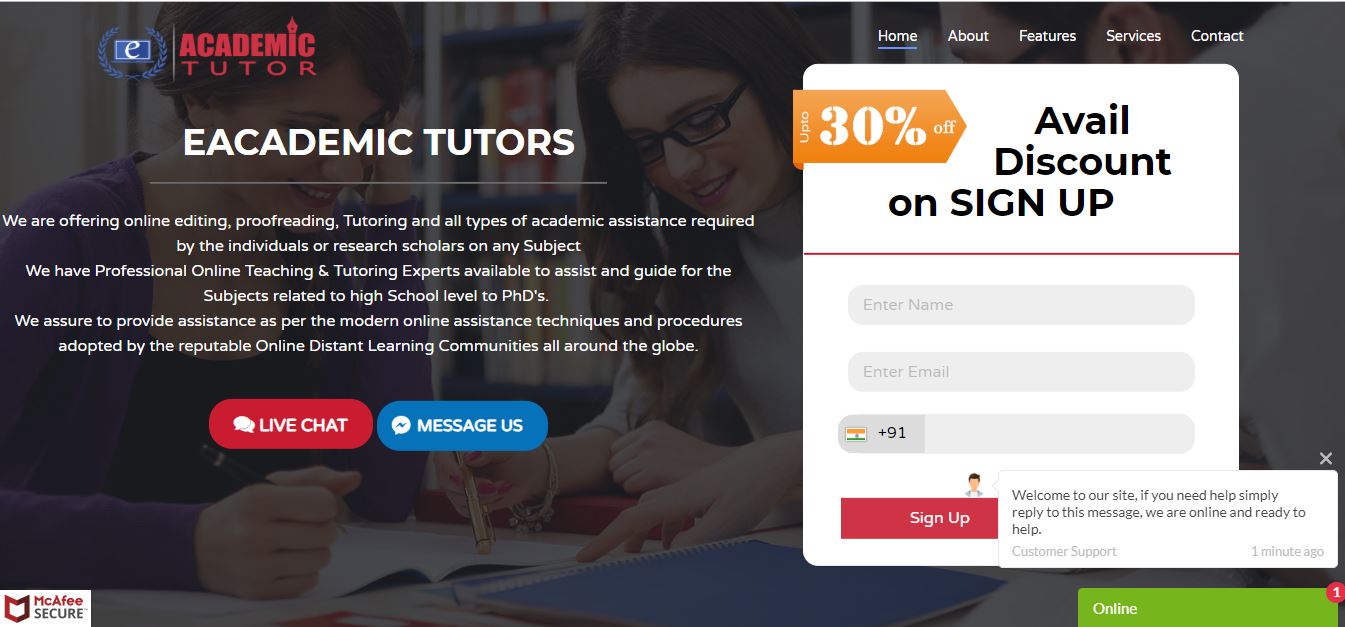
eacademictutor.co.uk Reviews
Services
eAcademicTutor.co.uk presents itself as an online tutoring and academic writing assistance platform offering subject-specific support for UK students. While the tutoring element could provide genuine academic benefit, the academic writing services offered by the platform fall short of genuine subject-specialist quality. Papers produced through the platform demonstrate insufficient subject knowledge for specialist or advanced-level courses.
For Students
Students at UK universities who have used eAcademicTutor.co.uk for course-specific academic support report limited benefit. The tutors available through the platform lack familiarity with the specific curriculum requirements, assessment styles, and academic cultures of different UK universities. Generic academic advice that does not account for institution-specific expectations is of limited practical value to students preparing for assessed coursework.
Prices
eAcademicTutor.co.uk charges per-hour tutoring rates and per-assignment writing fees that are competitive with established academic support providers but not justified by the quality of tutoring and writing assistance delivered. Cancellation policies and refund terms are restrictive, making it difficult for students to exit the service once dissatisfied without financial penalty.
Customer Support
The support experience at eAcademicTutor.co.uk is undermined by the limited academic expertise available through the platform. Tutors are not always accessible at agreed times, and the matching process that is supposed to connect students with appropriate subject specialists does not reliably produce the right matches.
Conclusion
eAcademicTutor.co.uk does not deliver the quality subject-specialist academic support that its platform promises. Students seeking genuine academic support should prioritise their university own tutoring services, verified subject-specialist tutors with demonstrable academic qualifications, and free academic writing resources.
Result
eAcademicTutor.co.uk scores 1 out of 5. The service fails to provide the subject-specialist academic support that students need and pay for.
Warning Signs to Watch Out For
eAcademicTutor.co.uk raises further concerns about the nature of the tutoring offered. Legitimate academic tutoring involves building a student own skills and understanding, while this service appears to offer completed work under the guise of tutoring assistance. The use of the tutor label may be a deliberate strategy to present contract cheating as legitimate academic support. Students should be aware that their institutions may take a serious view of this distinction.
Our Recommendation
For genuine academic tutoring that builds your own skills and understanding, seek support from your university tutoring programme, qualified subject mentors, or verified online tutoring platforms. For legitimate writing support on your dissertation or major essay project, ProjectsDeal.co.uk provides professional academic writing assistance with full transparency.
Looking for a Trusted UK Writing Service?
Thousands of UK students rely on ProjectsDeal for high-quality, guaranteed dissertation and essay support.
Best Dissertation Writing Service UK
✓ Native UK Writers | ✓ 100% Plagiarism Free | ✓ Money-Back Guarantee | ✓ On-Time Delivery
eAcademicTutor.co.uk Review: When "Tutoring" Becomes Contract Cheating
eAcademicTutor.co.uk presents itself using the language of academic tutoring — a framing that is designed to create ambiguity about what the service actually provides and to exploit the legitimacy that genuine tutoring services have in the minds of students and parents. Understanding the distinction between genuine academic tutoring and the contract cheating services that eAcademicTutor.co.uk provides is essential for students who are considering engaging with this platform.
Legitimate academic tutoring involves a qualified tutor working with a student to develop the student's own understanding and abilities. The tutor explains concepts, discusses ideas, reviews draft work, provides feedback, and helps the student identify and address gaps in their knowledge and skills. At no point in a legitimate tutoring relationship does the tutor produce assessed work that the student submits as their own. The student remains the author of everything submitted; the tutor's role is to help the student become a better author and thinker.
What eAcademicTutor.co.uk actually provides — based on the services advertised and the implicit offer of any service that provides "custom" academic content — is fundamentally different: documents produced by a third party for submission by the student as their own work. This is contract cheating regardless of the "tutor" framing the service uses, and UK universities treat it as such. The name a service gives itself does not change the nature of what it provides, and the academic integrity policies of UK universities apply to the product, not the marketing language used by the provider.
The Legal Significance of the "Tutoring" Framing
The use of "tutor" language by services like eAcademicTutor.co.uk is not accidental. It is a deliberate strategy to occupy the grey area between legitimate academic support (which is lawful and educationally valuable) and contract cheating facilitation (which is the target of UK regulatory action). Services that can credibly position themselves as providing "tutoring" or "academic support" rather than "essay writing" or "assignment completion" may have some insulation from the regulatory pressure that is building against more overtly named essay mills.
However, this framing is increasingly being tested by regulators and by universities' academic integrity policies. The QAA's guidance on contract cheating defines the prohibited conduct in terms of the nature of the output — work produced by a third party for submission as the student's own — rather than in terms of how the producing service describes itself. A "tutoring" service that produces essays for student submission is a contract cheating service under this definition, regardless of the commercial identity it has adopted.
The proposed UK legislation on contract cheating, modelled on the Irish and Australian legislation that has already been enacted, similarly focuses on the nature of the service provided rather than on how the service markets itself. Advertising, facilitating, or providing a service that produces academic work for submission by students would be an offence under the proposed legislation — and a service called eAcademicTutor.co.uk that produces essays would be covered, while a service called eAcademicTutor.co.uk that genuinely provides tutoring would not.
What Genuine Academic Tutoring Looks Like
Understanding what genuine academic tutoring looks like helps students assess whether a service like eAcademicTutor.co.uk is providing it. Genuine tutors in the UK are typically listed on platforms that verify their credentials — Tutor Association members, tutors registered with CRB (now DBS) checked platforms, academic professionals with verifiable university affiliations. They work with the student face-to-face or in live video sessions that allow real-time dialogue. They review the student's own draft work and provide feedback rather than producing new work from scratch.
Genuine tutoring sessions result in improved student understanding that is portable — the student can apply what they have learned in other assessments, in seminars, in employment. The student who emerges from a genuine tutoring relationship has developed; the student who receives a document from eAcademicTutor.co.uk has received a product. This distinction is recognisable to experienced academics and to the employers who later encounter the graduate, even if it is not immediately visible at submission.
The price point of services like eAcademicTutor.co.uk is another indicator. Qualified private tutors in the UK charge £30 to £100 or more per hour, reflecting their credentials, expertise, and the genuine educational value they provide. Essay mill services that use "tutoring" language but actually provide completed work are pricing what they provide — a document — rather than what a qualified tutor provides. Students should apply scepticism to any service that offers academic "tutoring" or "support" at prices that do not reflect the cost of a qualified professional's time in a genuine educational relationship.
Platforms that verify tutor credentials, provide session recordings, require live interaction, and allow the student's institution to audit the support provided are providing genuine tutoring. Platforms that accept assignment briefs, produce documents, and deliver them by email or download are providing contract cheating, regardless of the "tutoring" label attached to the service. eAcademicTutor.co.uk should be assessed against these criteria, not against its self-description.
How eAcademicTutor.co.uk Exploits Uncertainty About Academic Support Rules
Many students are genuinely uncertain about where the line between legitimate academic support and contract cheating lies, and services like eAcademicTutor.co.uk exploit this uncertainty. The academic regulations of UK universities can be complex, and students who are trying to determine whether a particular type of support is permitted may find themselves making decisions without full understanding of what their institution's policies actually say.
This uncertainty is real and understandable. Students who have had essay drafts reviewed by family members, peers, or writing centre staff — all of which can be legitimate under many institutional policies — may not immediately see the distinction between receiving feedback on their own draft and receiving a completed document produced by a third party. eAcademicTutor.co.uk's "tutoring" framing blurs this distinction, presenting contract cheating in terms that sound like the familiar and legitimate practice of seeking feedback.
The clearest rule for distinguishing legitimate support from contract cheating is the authorship test: does the work submitted represent the student's own ideas, analysis, and expression, with any external input acknowledged as required by the institution's referencing and attribution policies? If the answer is yes, the support received was legitimate. If the submitted work was substantially produced by someone else — including by eAcademicTutor.co.uk — the answer is no, and the submission constitutes academic misconduct regardless of what the producing service called itself.
Consequences of Using eAcademicTutor.co.uk for Assessed Work
The consequences of using eAcademicTutor.co.uk for work submitted to a UK university are the same as for any other form of contract cheating — the "tutor" framing does not create any mitigating factor in an academic misconduct investigation. A student who submits work produced by eAcademicTutor.co.uk and is found to have done so faces the standard academic misconduct process, with penalties ranging from mark penalties at first offence to exclusion for more serious or repeated misconduct.
One potential additional consequence specific to services that use ambiguous "tutoring" framing is that students may be poorly prepared to respond to investigation questions. A student who used a service that they understood to be providing tutoring support may not initially understand that what they received constitutes contract cheating. This misunderstanding does not protect the student from misconduct findings — the submitted work either is or is not their own, regardless of how they characterised the service they used — but it may delay the student from seeking appropriate advice and representation at the early stages of an investigation.
Students who have used eAcademicTutor.co.uk or similar services and are subsequently investigated should seek advice from their student union as early as possible. Student union advisers are experienced in navigating academic misconduct processes and can help students understand what defences or mitigations are available in their specific circumstances. Acting on this advice before the formal investigation meeting — rather than attempting to manage the process without support — typically produces better outcomes.
Detection of work from eAcademicTutor.co.uk follows the same pathways as detection of any contract cheating: automated plagiarism tools, stylometric inconsistency analysis, AI detection tools, marker experience with the student's established work, and in some cases intelligence from the QAA's contract cheating monitoring activities. The "tutoring" framing does not insulate the submitted work from these detection mechanisms.
The Online Dimension: "e" Academic Tutoring
The "e" prefix in eAcademicTutor.co.uk signals an online-only service, which creates specific characteristics that students should understand. Online-only academic support services that cannot demonstrate verifiable tutor credentials, cannot provide live session recordings, and cannot be audited by a student's institution offer none of the accountability that makes genuine tutoring educationally valid and institutionally acceptable. An anonymous online service that accepts assignment briefs and delivers completed documents is not providing "e-tutoring" — it is providing contract cheating through a digital channel.
The online-only model also means that the student has no relationship with a verified individual. Unlike a private tutor who is known by name, whose credentials have been checked, and who can be held to account for the content of their sessions, the "tutors" at eAcademicTutor.co.uk are anonymous contractors whose qualifications, subject expertise, and quality of work cannot be independently verified. The service positions itself as connecting students with qualified tutors, but the quality assurance mechanisms that make this claim credible are absent from the platform's publicly available information.
Online platforms that provide genuine academic tutoring in the UK include those that verify tutor qualifications, provide session recordings that students can share with their institution if required, and operate with transparent terms of service that clearly describe the nature of the support provided. eAcademicTutor.co.uk does not demonstrate these characteristics, and students should treat the absence of transparent verification as a significant warning sign about the nature of what is actually being offered.
Data Privacy and Security at eAcademicTutor.co.uk
Using eAcademicTutor.co.uk requires submitting personal and academic information to a service whose data handling practices and regulatory compliance cannot be independently verified. Assignment briefs submitted to eAcademicTutor.co.uk may contain the student's name, student number, module code, institution, assignment title, and other identifying academic information. This information, submitted to an unregulated online platform, enters a data environment where the student has no meaningful control over subsequent use.
The UK General Data Protection Regulation requires any organisation that processes personal data about UK residents to be registered with the Information Commissioner's Office, to have a lawful basis for processing, to apply appropriate security measures, and to respond to data subject rights requests including the right of erasure. Compliance with these requirements by eAcademicTutor.co.uk cannot be independently verified from publicly available information, and enforcement against an overseas operator with no identified UK presence is not straightforward.
The practical consequence for students is that information submitted to eAcademicTutor.co.uk may be retained indefinitely, shared with third parties, or used in ways that the student did not consent to. Academic assignment briefs are particularly sensitive because they can be used to identify the student's institution, their course, and the specific assessment they are being examined on — information that has value to others in the contract cheating industry and that the student would typically not want to be circulated beyond the intended recipient.
Payment information submitted to eAcademicTutor.co.uk carries additional risk. Online payment through an unverified platform creates exposure to card skimming, unauthorised recurring charges, and data theft. Students who are concerned about these risks should use payment methods that provide strong fraud protection and easy dispute resolution, and should monitor their accounts carefully after any transaction with a service like eAcademicTutor.co.uk.
Legitimate Alternatives to eAcademicTutor.co.uk
Students who are looking for the kind of personalised academic support that eAcademicTutor.co.uk claims to provide have access to genuine alternatives that provide real educational value without the risks associated with contract cheating. The key difference between these alternatives and eAcademicTutor.co.uk is that genuine alternatives help the student do better work themselves, rather than replacing the student's work with someone else's.
University academic skills centres and learning development services offer workshops, online resources, and individual appointments that cover all aspects of academic writing and study skills. These services are staffed by professionals with genuine educational expertise and are specifically calibrated to the requirements of UK higher education assessment. They are free to enrolled students and are explicitly sanctioned by universities as legitimate forms of academic support.
Private tutoring through verified platforms — those that conduct DBS checks on tutors, verify qualifications, and allow the student's institution to audit the support provided if required — is a legitimate option for students who need subject-specific academic support beyond what university services provide. The Tutors' Association and similar bodies provide a framework for identifying tutors who operate to professional standards. These tutors work with the student's own ideas and drafts; they do not produce assessed work.
Peer study groups and university-facilitated peer learning programs offer collaborative support in which students help each other understand material without crossing the line into contract cheating. Many universities facilitate formal peer learning programs in which senior students provide subject-specific support to junior students. These programs provide the social dimension of learning that is missing from anonymous online services and develop the collaborative academic skills that employers value.
Summary: eAcademicTutor.co.uk uses tutoring language to obscure what is fundamentally a contract cheating service. Students who use it for assessed academic work are engaging in academic misconduct regardless of the service's self-description. Genuine academic tutoring is available through university services, verified private tutor platforms, and peer learning programs — all of which help students develop their own capabilities rather than creating the compliance, detection, and exploitation risks associated with eAcademicTutor.co.uk.
The Academic Integrity Policy Landscape for UK Students
Every UK university has an academic integrity policy that defines what constitutes misconduct and what the consequences are. These policies have been substantially updated in recent years in response to the growth of essay mills, and they now typically contain specific provisions addressing contract cheating — the submission of work produced by a third party regardless of how that production relationship was described or priced. Students who use eAcademicTutor.co.uk are subject to these policies irrespective of whether they understood what the service was providing.
The QAA's Good Practice Note on Contract Cheating and the associated resources provide a framework that most UK universities now follow. Under this framework, contract cheating includes any arrangement where a student submits as their own work a piece produced in whole or in part by another person or organisation, where the submission creates a false impression that the work is the student's own. The "in part" element is significant: a student who receives a completed essay from eAcademicTutor.co.uk and rewrites sections of it has still engaged in contract cheating if the core structure, argument, and content remain from the third-party source.
Universities' investigation processes have become more sophisticated in parallel with the evolution of essay mill services. Investigation panels now regularly include members with experience of stylometric analysis, AI detection, and the business models of essay mills — including services that use tutoring language. A panel that understands how eAcademicTutor.co.uk operates is better placed to ask questions that distinguish students who wrote their own work with legitimate support from students who submitted third-party produced content.
Students who are in any doubt about whether a particular form of academic support is permitted should check their institution's academic integrity policy and ask their personal tutor or a student support adviser before using the service. This is particularly important for services like eAcademicTutor.co.uk that use language (tutoring, support, guidance) that could describe either legitimate or illegitimate help depending on what is actually provided. When in doubt, seeking clarification from the institution takes the uncertainty away in the safest possible way.
Contract Cheating and Employer Trust
The relationship between academic qualifications and employer trust is a dimension of contract cheating that students frequently underweight when they are under deadline pressure. A UK degree is a credential that employers use to make hiring decisions, and the value of that credential depends on the reliability of the certification it represents. When graduates who used services like eAcademicTutor.co.uk to pass assessments enter employment and demonstrate capabilities inconsistent with their certified level of academic achievement, this erodes employer trust in academic credentials more broadly — a harm that extends beyond the individual graduate to every student who earned a genuine qualification.
For employers who invest in graduate development programmes that assume a certain level of academic capability at entry, discovering that graduates lack the skills their qualifications certify is a costly and damaging experience. Some employers have responded to this by adding their own assessments to recruitment processes, by verifying academic records more carefully, and by building relationships with universities that can provide more detailed information about graduates' academic performance. These responses represent a systemic erosion of trust that is partly attributable to the prevalence of services like eAcademicTutor.co.uk.
In roles that require ongoing professional development and revalidation — healthcare, social work, teaching, law — employers who discover that a professional's foundational qualifications were obtained through contract cheating face significant regulatory and reputational consequences. The professional licensing bodies that regulate these fields take a serious view of findings that qualifications were obtained through fraud, and employers who knowingly employ individuals with fraudulently obtained qualifications may face their own regulatory exposure. These pressures create incentives for employers to take an increasingly active interest in the integrity of the academic qualifications they rely on.
Recognising and Avoiding Services Like eAcademicTutor.co.uk
Students who are looking for academic support can use several indicators to distinguish genuine tutoring services from contract cheating services that use tutoring language. These indicators are not infallible, but they provide a practical framework for making a preliminary assessment of any service that presents itself as an academic tutor or support provider.
The most important indicator is whether the service requires the student to submit an assignment brief that it will then fulfil. A genuine tutoring service does not work from assignment briefs — it works with the student's own developing understanding and draft work. If the first thing a service asks for is the assignment title, due date, required grade, word count, and format, it is providing essay writing, not tutoring, whatever it calls itself. eAcademicTutor.co.uk should be assessed against this fundamental test.
The transparency of the service's operation is another key indicator. Genuine tutoring services identify their tutors, provide verifiable credentials, explain their approach to educational support, and operate transparently in terms of what they do and do not provide. Services that hide behind generic website copy, do not identify individual tutors, and do not clearly describe the boundary between support and completion are providing something other than genuine tutoring.
Review sites that aggregate student experiences of tutoring services can provide useful information, but students should apply the same scepticism to reviews of essay mills that they would apply to any commercial review ecosystem. Services like eAcademicTutor.co.uk may generate positive reviews through incentive programmes, may moderate negative reviews, or may operate multiple branded identities with no reviews under the current brand name. Independent reviews on platforms that verify reviewer identity or that aggregate complaints rather than positive endorsements provide more reliable signals.
If in doubt, the safest approach is to ask the service a direct question: "Will you produce a document for me to submit as my own work, or will you support me in producing my own work?" A genuine tutoring service will clearly answer the second option. A contract cheating service using tutoring language will either give an evasive answer or will reveal that it is providing the first option. Students who receive an evasive response should treat this as a clear signal to look elsewhere.
The Psychological Cost of Contract Cheating
Students who use services like eAcademicTutor.co.uk do not only face external consequences — they also face internal costs that are rarely discussed in the context of academic integrity enforcement. The experience of submitting work that is not your own, of building a credential on a foundation that you know is partly fraudulent, and of carrying the risk of detection through your remaining time at university and into your career, creates ongoing psychological strain that can be significant.
Students who have used contract cheating services often describe the experience of attending seminars, speaking with supervisors, and sitting examinations in the same module as one of ongoing anxiety — the worry that each interaction might reveal a gap between the sophistication of the submitted work and the student's actual understanding. This anxiety is not irrational: the gap is real, and interactions that probe genuine understanding will eventually reveal it. The student who used eAcademicTutor.co.uk to produce one essay may spend the rest of the module managing the consequences of that single decision.
For students who have used such services more extensively, the psychological cost can be compounding. A student who has used contract cheating across multiple assessments has built a larger and less stable foundation, and the stakes of detection are higher at each subsequent level of study. Students in this situation may find that the anxiety of managing the ongoing risk is itself an impediment to genuine academic engagement, creating a cycle in which each new assessment feels impossible to complete genuinely because the student's understanding is insufficiently developed.
Student counselling services at UK universities are experienced in working with students who are under significant academic pressure, including students who have made decisions about academic support that they now regret. These services provide confidential support and can help students develop strategies for addressing both the immediate assessment pressures and the longer-term patterns that led to those decisions. Counselling support is not a guarantee of academic outcomes, but it provides a framework for making better decisions — decisions that do not involve eAcademicTutor.co.uk or similar services.
eAcademicTutor.co.uk and the Student Financial Vulnerability
Students in the UK face significant financial pressures, particularly since the introduction of higher tuition fees and the reduction in maintenance support. These pressures are directly relevant to the essay mill industry: students who are working long hours in part-time employment to fund their studies have less time for academic work, and the combination of deadline pressure and financial strain creates exactly the conditions in which services like eAcademicTutor.co.uk look attractive. The essay mill industry is, in part, a commercial response to systemic pressures on students — it monetises the gap between what students are expected to produce and the time and resources they have available to produce it.
Understanding this context does not change the consequences of using eAcademicTutor.co.uk — it remains contract cheating regardless of the circumstances that led to it — but it does point to the structural solutions that could address the underlying drivers of demand. Universities that invest in accessible support, flexible assessment practices, and genuine recognition of the pressures students face are addressing the demand side of the essay mill market. Students who are in financial difficulty should access the financial hardship support that their university provides rather than spending additional money on services like eAcademicTutor.co.uk that create further costs without providing lasting benefit.
Student finance hardship funds, emergency grants, and bursaries are available at most UK universities and can provide financial relief that reduces the pressure to prioritise paid employment over academic work. The student union typically administers independent financial advice services that can help students identify what support they are entitled to. These are the appropriate responses to financial strain — not spending money on a contract cheating service that creates additional risks while producing a document that the student cannot genuinely stand behind.
What to Do if You Have Already Used eAcademicTutor.co.uk
Students who have already used eAcademicTutor.co.uk and have submitted the resulting work to their university are in a difficult but not necessarily hopeless position. The options available depend on whether the submission has been assessed yet, whether a misconduct investigation has been initiated, and what evidence is available about the circumstances. Acting promptly and seeking appropriate support is always preferable to continuing in a state of uncertainty about the risk.
Students who have submitted work but have not yet received a grade should consider whether they want to take any proactive steps before an investigation is potentially initiated. In some cases, students have chosen to disclose concerns about their submission to their personal tutor or the module leader before receiving feedback. Universities vary in how they respond to voluntary disclosure: some treat it as a significant mitigating factor; others follow the same process regardless. A student union adviser can help assess the likely response at a specific institution before any disclosure is made.
Students who are under active investigation should seek student union advice immediately. The investigation process has formal stages, and students have rights — including the right to be accompanied at meetings, the right to see the evidence against them, and the right to appeal a finding. These rights are most effectively exercised with the support of an experienced student union adviser who is familiar with the institution's academic misconduct regulations and investigation processes.
Students who have completed their degree using contract cheating services and are concerned about the long-term integrity of their credential are in a complex situation that requires careful handling. The range of options is narrower, but student support services and independent legal advice can help assess what, if anything, can or should be done. The most important thing is to avoid actions that compound the original problem — continuing to misrepresent capabilities built on fraudulently obtained credentials in regulated professional contexts creates risks that are additional to and separate from the original academic misconduct.
Final Assessment: eAcademicTutor.co.uk Is Not a Tutoring Service
The analysis on this page consistently supports a single conclusion: eAcademicTutor.co.uk, regardless of its name, is a contract cheating service that provides assessed academic work for student submission rather than genuine educational support that develops the student's own capabilities. The "academic tutor" framing is a marketing strategy, not a description of the service's educational function.
Students who use eAcademicTutor.co.uk face the same risks as students who use any other essay mill: academic misconduct investigations, detection through multiple mechanisms, data privacy exposure, financial risk, and long-term skill deficits that compound through subsequent education and employment. The tutoring language does not reduce any of these risks — it may create additional confusion for students who misunderstand the nature of the service they are using, which can itself complicate the response to a subsequent investigation.
The genuine alternative to eAcademicTutor.co.uk is genuine academic support: university learning development services, verified private tutors, academic writing centres, peer learning programmes, and honest engagement with supervisors and module leaders about the specific difficulties the student is experiencing. These alternatives are more work than submitting a brief to eAcademicTutor.co.uk and waiting for a document, but they produce outcomes that are actually beneficial — developed understanding, legitimate credentials, and a foundation for further study and professional work that eAcademicTutor.co.uk is structurally unable to provide.
If you are looking for genuine academic tutoring, the Tutors' Association website lists registered tutors in the UK who operate to professional and ethical standards. If you are struggling with academic work, your university's student support team and student union can help you identify the right support for your situation. Neither of these options is eAcademicTutor.co.uk.
This review of eAcademicTutor.co.uk is provided to help students in the UK make informed decisions about academic support services. The analysis draws on publicly available guidance from the Quality Assurance Agency for Higher Education, the Information Commissioner's Office, and published research on contract cheating in UK higher education. Students with questions about their specific situation should contact their institution's student support service or student union before taking any action that could affect their academic standing or record.
Key resources: The QAA's contract cheating information page provides guidance for students on what academic misconduct means and what support is available. UCAS provides information about declaration requirements for applicants who have academic misconduct findings on their record. The National Union of Students publishes guidance on student rights in academic misconduct proceedings, including the right to representation and the right to appeal. Your own university's student services and student union are the most direct and most appropriate first point of contact when you are facing any difficulty with your academic work, including considerations about whether to use services like eAcademicTutor.co.uk.